
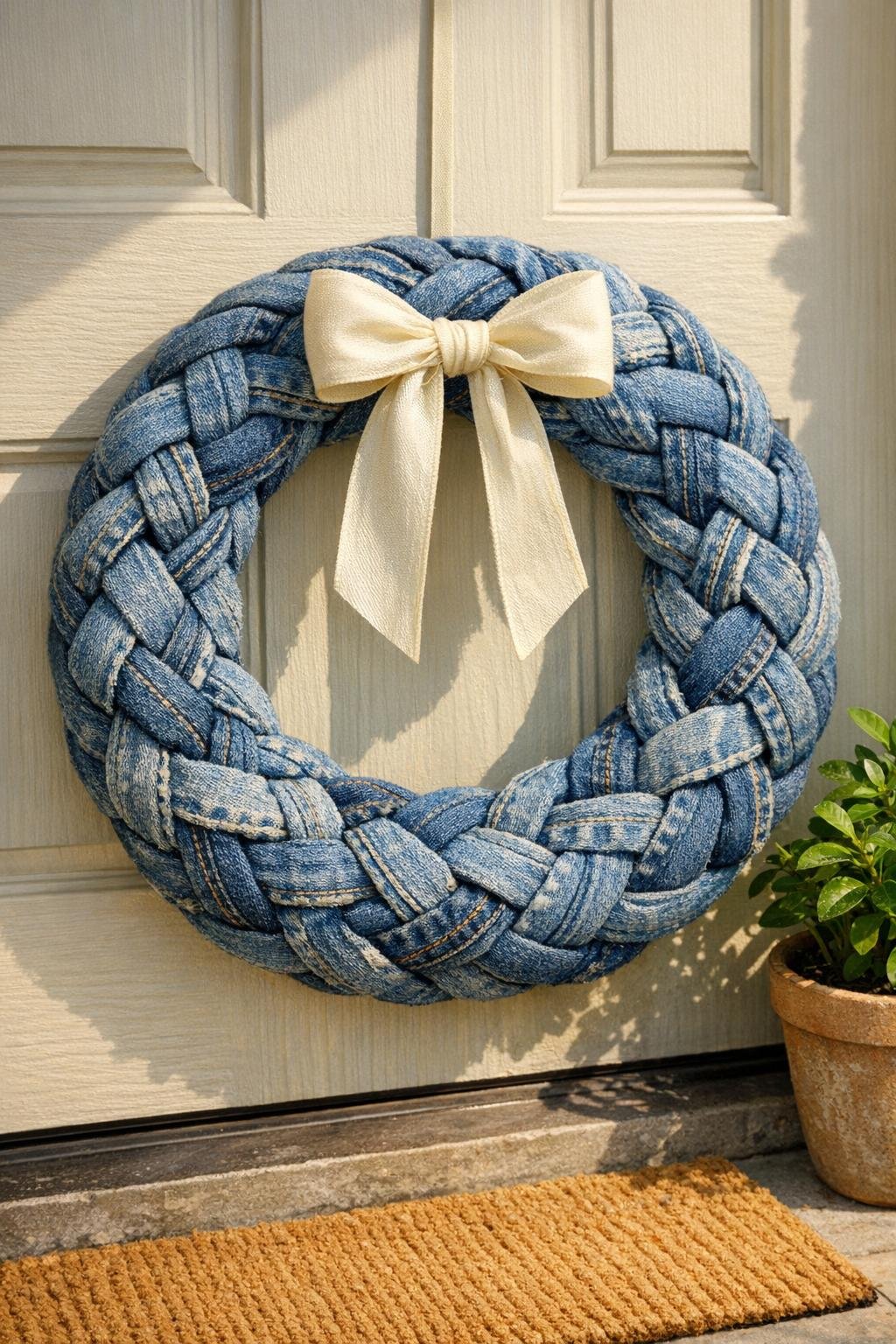
I love a project that makes something useful out of a pile most of us already have, and this braided denim strip door wreath is exactly that kind of win. Old jeans turn into a thick, ropey wreath with wonderful texture, soft color variation, and the kind of casual polish that works on a front door, mudroom hook, or even over a pantry door.
What I especially like about this one is that the “smart” part isn’t just that you’re reusing denim. Braiding the strips gives you a sturdy, flexible wreath with a lot of visual fullness without needing fancy supplies or difficult techniques. If you can cut, braid, and wrap, you can make this — and because denim comes in so many faded blues, the finished wreath ends up looking layered and intentional with very little fuss.
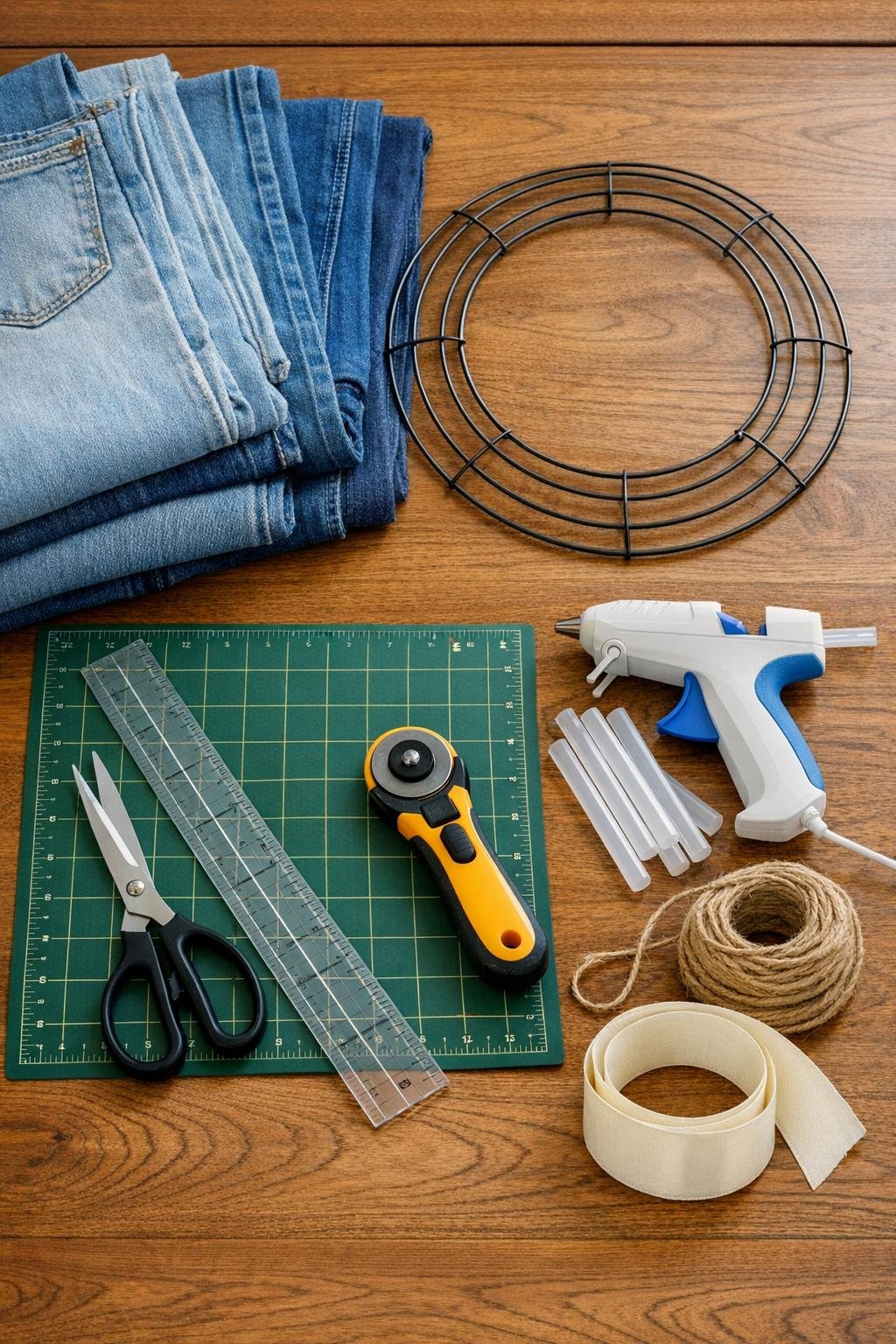
Materials
Instructions
1. Cut the legs off the jeans and slice them open along one seam so you can lay the denim flat. Trim away thick inseams, hems, pockets, and bulky stitched areas so your strips stay easy to braid.
2. Cut 36 long denim strips measuring 2 inches by 30 inches, mixing light, medium, and darker faded blues for a richer finished look. Cut 12 shorter tying strips at 1 1/2 inches by 12 inches.
3. Gather 3 long strips, line up the ends evenly, and tie them together tightly with one short denim strip about 1 inch from the top. Repeat until you have 12 tied sets ready to braid.
4. Braid each 3-strip set into a firm, even braid, keeping steady tension so the braid looks full but not twisted. Tie off the bottom of each braid with another short denim strip.
5. Stretch one braid gently lengthwise to settle it, then wrap it around the metal wreath form to check the fit. You will need several braids joined end to end to cover the form thickly.
6. Overlap the end of one braid with the start of the next by 1 1/2 inches and secure the overlap with hot glue plus a tight wrap of jute twine. Continue joining braids until you have one long braided rope about 100 to 110 inches long.
7. Starting at the back of the wreath form, glue the first end of the braided rope onto the metal ring and wrap it around the form snugly. Keep each round close to the previous one so the wreath looks dense and generously covered.
8. Continue wrapping the braid all the way around, adding a small dot of hot glue on the back every 4 to 5 inches to keep it from shifting. Rotate the braid slightly as needed so the prettiest side faces forward.
9. When you reach the starting point, trim the final braid end so it overlaps neatly by about 1 inch. Glue it down securely on the back, then wrap the join with the small denim piece for a clean, finished look.
10. Fluff and adjust any frayed edges with your fingers so the braid looks even and full all around. If you like, make a simple bow from the ribbon and glue or tie it at the top or lower side of the wreath.
11. Cut a 12-inch piece of ribbon or jute twine, loop it through the top of the wreath form, and knot it securely for hanging. Hang the wreath and step back to make sure the braid spacing is balanced and the front looks nicely rounded.
Variations & Tips
Frayed-edge look: If you enjoy a more rustic wreath, leave the strip edges untrimmed and let them soften naturally as you braid. Denim fray gives the wreath extra volume and a relaxed, lived-in charm.
More color depth: Use jeans in at least three different washes, from pale faded blue to deeper indigo. That mix keeps the braid from looking flat and gives the wreath the same kind of contrast I like building into a good composed dish.
Add a seasonal accent: Tuck in faux eucalyptus, a few dried stems, or a small plaid ribbon for fall and winter. Keep additions clustered in one area so the denim braid still stays the star.
No metal form: You can substitute a 14-inch wreath base cut from sturdy cardboard and wrapped first with scrap fabric or twine. The metal form is sturdier, but the cardboard version works well for an indoor door or wall.
Make it fuller: If your braid coverage looks thin, cut 3 to 6 extra strips and make one more braid to wrap over sparse areas. Denim compresses a bit as you handle it, so a little extra always helps.
Best cutting tip: I find denim behaves much better when the jeans are freshly washed and fully dried before cutting. Clean denim lies flatter, sheds less dust, and is easier to measure accurately.